
COLD DEW's "欲欲 / Yuyu"
What do you get when you mix old-school Taiwanese pop vocals with modern psychedelic rock instrumentals? My new favorite band, that's what

If you walk through the streets of Taipei, especially in a public area like Da’an Forest Park, you’re likely to see an elderly person with a speaker and a microphone singing old Chinese and Taiwanese songs from the 70s and 80s. These songs fall under a few genre labels, including Taiwanese Campus Folk Songs (校園民歌), Mandopop, and Hokkien pop, but they have some common elements, like their wistful romantic vocals, blues-tinged chord progressions, and synth patches (or strings) that ooze with nostalgia.1
The vocal style of COLD DEW, an indie band formed in 2018, is very reminiscent of these old-school Taiwanese songs (“street blues,” as the band calls them on their bandcamp page). The melodies are simple but full of emotion, and 林哲安 Lin Zhe-An’s singing is decadent, his rich baritone hanging onto each syllable just a little bit too long. But, rather than having the vocal lines float over romantic synth-y backing tracks like the classics do, COLD DEW puts their melodies into the context of modern Taiwanese indie music, letting them mingle with distorted rock solos, echoey guitar riffs, modular synthesizers, noise, and hand percussion. It’s incredible how well these elements are made to work together. The retro-style melodies are strong enough to hold their own against many different instrumental environments, allowing COLD DEW to push boundaries with their song structures — and despite the wide range of moods covered by the sometimes wild instrumentals, the vocals always feel like they naturally belong. The modern elements bring something new out of the older song styles, accentuating rather than essentializing them. COLD DEW brings the melodies into a fresh context where, rather than evoking days gone by, they convey the meaning that these songs have for people in the present, like the young musicians hearing street singers in the park on their way to the studio, electric guitars strapped to their backs.
You might mistake 欲欲 / Yuyu for an EP, seeing as it only has three tracks (or four, if you count the vinyl bonus track). I’d argue, though, that within those three tracks there exist significantly more than three songs. One of COLD DEW’s strengths is their transitions, which they use to pack their longer tracks with multiple melodies and distinct sections, moving across genres smoothly and frequently. The album’s second track, “山地情歌 / San-Di Love Song” is over 18 minutes long, but that 18 minutes is a rollercoaster. The first 4 or 5 minutes is a noise music track, with a slowly building drone and fuzz texture supplemented by cymbals and a bloopy semi-modular synth patch.2 The growing drums then take over and make way for a hardcore-style breakdown and an increasingly chaotic distorted guitar solo. Eventually, as the drum beat slows, a melodic psychedelic guitar vamp arises out of the chaos. This transforms into, in order, a surf-rock-esque tambourine two-beat, a romantic sing-song ballad, an African hand drum rhythm, a dancey blues rock number, an environmental soundscape, and then back to hard rock. Each of these transitions is devised and executed expertly to keep the track moving forwards, never losing momentum. The big noticeable shifts are exciting, of course, but just as fantastic are the countless small transitions — the minor chord thrown into the second chorus of the ballad section, or the switch from two-beat to four-beat groove leading up to the final climax — these subtle vibe adjustments are what really pushes the music forward and keeps it constantly exciting.
The other aspect that makes COLD DEW’s mid-track transitions noteworthy is that they’re playful and creative. No two are the same, and more often than not they take you in an unexpected direction, leading to an unexpected delight. The third track “溫泉 / Hot Spring,” for instance, calls into question what makes a transition satisfying in the first place. Even more than the rest of the album, this track evokes the Taiwanese street blues aesthetic by borrowing extra elements from those songs for the backgrounds, like their chord progression, drum beat, and nostalgic echoey synth sounds. The biggest homage, though, is a transition in the middle of the track, where the instrumental all but cuts out, leaving space before the beat starts up again with a new instrumental — still a retro aesthetic, but one clearly distinct from the first (different drum beat, in a minor key instead of a major one). This transition, rather than being smooth, mimics perfectly the feeling of the little pause after a street singer finishes singing a song, before the next karaoke track autoplays on their portable PA system. It’s an awesome moment, both true to life and musically interesting. The passage is deliberately awkward, and in it’s awkwardness is able to conjure up a vibe which a smooth transition could never create.
The inclusion of the two sub-songs on the track isn’t arbitrary, either. Their juxtaposition is notable in a couple different ways. As a whole, the track is about the hot springs of Beitou district in the northern part of Taipei. After a two minute instrumental intro that has a naturalistic energy to it, calling to mind the primal volcanic forces bubbling the water up out of the ground, the first melody begins. The song is a relaxed (almost beachlike) ballad, waxing poetic about how lovely it is to soak in the hot spring:
我們 要去那地方
We are going to that place
有蒸氣、硫磺,還有那白色的
where there is steam, sulphur and that white
我們 要去那地方
We are going to that place
一個寄放心靈的山坡上
A hillside to rest your soul
The song that occupies the latter half of the track takes on a different vibe, starting with a minor enka-style intro complete with an airy synth pad, and then quickly moving into a rock drum beat and distorted guitar solo. Along with a walking bassline, this more intense rock vibe is what accompanies the new vocal melody, singing:
金錢難買愛
Can't put a price on true love
北投我心徘徊
Beitou lingers in my heart
At first glance, these lines might appear like they would fit right in with the first part of the song; they’re both about the same place, after all. There’s an important distinction that sets them apart, though: instead of Mandarin, these lines are sung in Taiwanese. Taken together with the different instrumental influences of the track’s sections3, we get a whole picture of two different classic evocations of the hot springs, first from a Mandopop, then a Hokkien pop angle.
COLD DEW isn’t just good at crafting multi-part songs full of transitions and diverse musical influences — they can also write a killer standalone hit. This is clear from the first track (and my favorite on the album), “雲 / Cloud." This song is mesmerizing. It kicks off with a floaty texture that just draws you in, proceeding with a catchy guitar hook and a lovely slow groove that sets up the beautiful vocals perfectly. The best thing about the track, though4, is how naturally it builds and subsides. The lead up to the climax of the guitar solo with the backing instrumental getting subtly noisier and noisier is so well executed, and the outro with the two-guitar counterpoint grinding to a halt is maybe the best moment of the whole record.
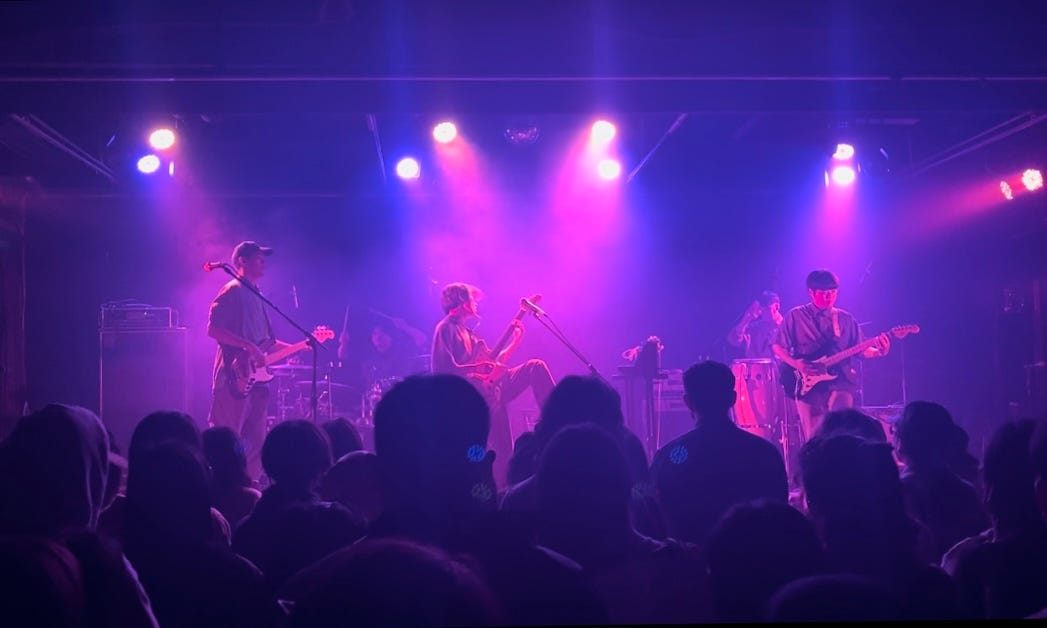
I usually don’t talk about bonus tracks on this blog, but I want to put in a special mention for the bonus track on 欲欲 / Yuyu, which is a live recording of their song “六神無主 / In a Daze.” This track leaves off directly from the outro guitar riff of “溫泉 / Hot Spring,” and, besides just being too good not to mention, brings some of the best elements from COLD DEW’s live shows onto the album. The shows I saw the band at had two things that made them especially fun beyond what you hear on the record. The first was the element of harsh, uncontrolled noise, leaning harder into the psychedelic rock5 influence. The second was the introduction of incredibly danceable beats and grooves — the live band featured a second percussionist just for hand percussion, which led to a number of moments where the audience went from being mesmerized in the wash of distorted fuzz to dancing the samba to the sounds of the conga. “六神無主 / In a Daze” captures this wilder side of COLD DEW beautifully, along with the charm of a somewhat more raw vocal performance from 林哲安 Lin Zhe-An. You can listen to the track (or the full album) on Bandcamp below.
COLD DEW is a band which can do a bunch of things incredibly well. If you want simple, beautiful melodies with lovely low-key supporting instrumentals, you got it. If you want intricate instrumental rock with noise elements and great sound design, you got it. If you want cool riffs and burning guitar solos, you got it! What makes 欲欲 / Yuyu a truly great album, though, is how the band puts all of these tools to use in crafting a project with individuality and soul, one which explores the place of 70s and 80s Taiwanese music in modern life in a way that no one else is doing. COLD DEW nurtures a symbiosis between these retro aesthetics and modern psychedelic noise rock that is unique, charming, and incredibly fun to listen to.
Happy Listening!
For maximum nostalgia, I have provided the Mandopop example in the form of a random youtube video rather than a spotify link.
They used the Korg MS-20 onstage in their live performance, so I assumed that’s the synth used on the record, too (the sounds seem to match up). It could be a different (non semi-modular) synth, though, I guess. Either way there’s definitely some amount of knob turning involved.
Despite Taiwanese artists playing a large role in both genres’ development, Mandopop and Hokkien pop have different musical lineages, with Japanese enka music having a stronger influence on the latter (as far as I’ve heard/read, at least). This difference is reflected in the instrumental tracks for the different parts of “溫泉 / Hot Spring,” although both sections also introduce extra elements beyond the original song archetypes, of course.
(in my opinion)
I’ve been writing a lot about psychedelic music lately; part of the reason is because I’ve been listening to a lot of it, but part of the reason is that there are a lot of really cool ways that Taiwanese bands are incorporating psychedelic influences into the current indie music culture. Just looking at what I’ve talked about on here, the past three bands all carry the “psychedelic” label but each have vastly different sounds (and appeal to fairly different audiences). Anyway, this is all to say, if you prefer other types of indie music, not to worry! I’ll be going back to covering some other genres in the coming weeks.